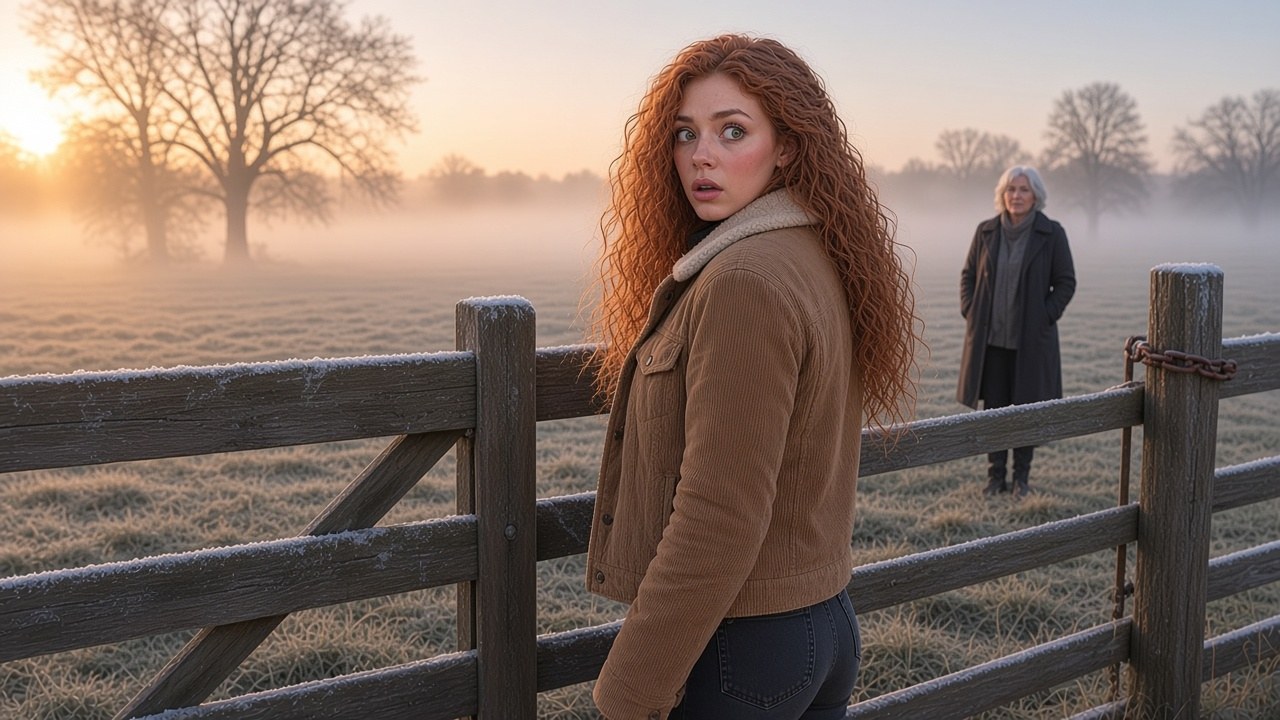
Just finding Lana’s story? Read Part 32 here to catch up on the sheriff’s confession at the pasture gate, the report Cole never filed, Annie’s choice, and the page Rita handed to Vera.
Last time, Sheriff Cole Pruitt finally told us what happened at the creek crossing twenty-three years ago.
He climbed down the bank in the dark. He found the driver’s door swinging open in the current.
And at the top of the bank, Clay Kettering was waiting with Annie. Alive, soaking wet, wrapped in a horse blanket in his truck.
Cole wrote “driver not recovered” and signed his name. Then he locked the report in his desk drawer for twenty-three years.
Annie decided she would tell Vera the truth herself. Rita only smiled and said, “Ask Cole what was in the back seat.”
Then Royce’s blue Chevy came rattling down the field road. And Vera climbed out.
Rita handed her page two. Old paper, soft at the folds, in Cole’s own handwriting.
It said he went into the water for a little girl. It said he pulled her out of the back seat.
“Vera,” Annie said. “That’s not what happened.”
And Cole looked at Annie like he didn’t believe her either.
Red Mittens
For a long time, nobody said anything at all.
The sun was all the way up now. It lit the frost on the pasture until the whole field looked like broken glass.
Vera stood there holding page two with both hands, like the wind might snatch it away.
“Cole,” she said. “Look at me.”
He opened his eyes. It took him a while.
“Was I in that car?”
I have watched Cole Pruitt hide things from me. In his glovebox. In his desk drawer. In the way he answers a question with another question.
But I had never watched him try to lie and fail. Not until that second.
“Yes,” he said. “You were.”
June’s hand tightened on mine so hard it hurt. Royce made a sound beside me like somebody had knocked the air out of him.
Annie closed her eyes.
“I said the car was empty because that’s what I promised to say,” Cole went on. “And for twenty-three years, that’s what I’ve said.”
“The truth is, when I got down there, the front seat was empty. The back seat wasn’t.”
He looked at the paper shaking in Vera’s hands.
“I wrote that page at my kitchen table at five o’clock the next morning,” he said. “I couldn’t stand having only the lie written down anywhere.”
“So I wrote the truth one time. Then I locked it in the drawer, right underneath the lie.”
Vera’s voice came out very small. “Tell me.”
Cole rubbed the back of his neck. When he talked again, he wasn’t talking to any of us. He was talking to her.
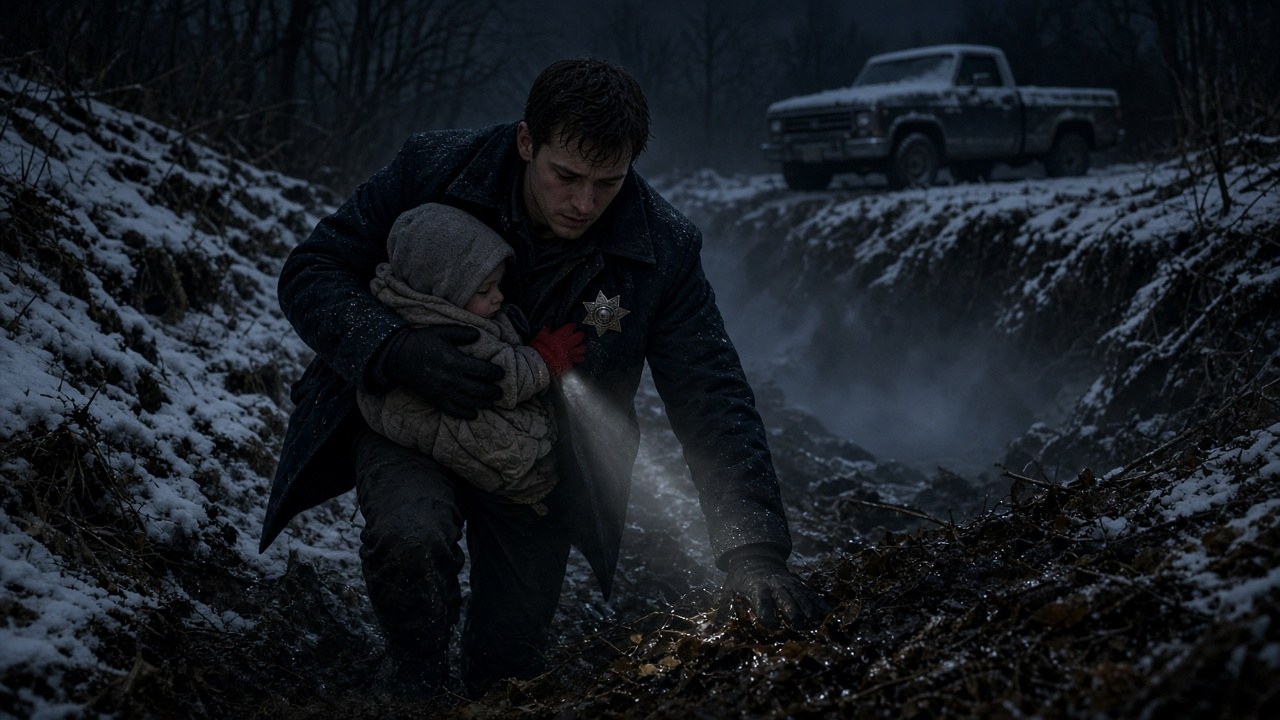
“There was a car seat buckled in behind the passenger side. The water was already up past the cushion.”
“You weren’t crying. That’s what scared me the most. You were just sitting there real still, looking at my flashlight.”
“The current had the back door pinned shut. So I broke the window out with the end of my light.”
“You had on little red mittens,” he said. His voice went rough. “One of them came off in the water. I always wondered if anybody ever found it.”
Vera looked down at her own hands. The long fingers. The crooked pinky.
“I carried you up that bank inside my jacket,” Cole said. “You grabbed on to my badge and you would not let go.”
“Clay had to pry your fingers off it at the top.”
Vera slowly turned her right wrist over. There’s a thin white scar there, just below her thumb. I noticed it the first week I met her.
“I always thought I got this on barbed wire,” she whispered. “Clay told me it was barbed wire.”
Nobody told her different. Nobody had to.
It Was Your Car, Annie
“Why?” Vera said. “Why would you lie about that? Why would Clay?”
“Because Clay asked me to,” Cole said. “Right there at the top of the bank, with you bundled up in that horse blanket next to your mama.”
“He said, ‘Cole, if this county finds out that baby was in the water tonight, they’re going to ask who put her there.'”
“‘And then they’ll take her away from both of us.'”
Rita smiled a little. Like she’d been waiting all morning for exactly that line.
Cole didn’t look at her. He was looking at Annie now. And for the first time since sunrise, I saw something in his face that wasn’t guilt.
It was hurt. Old hurt. The kind you carry so long you forget how heavy it is.
“It was your car, Annie,” he said quietly. “You were the one soaking wet. And Clay never once said any different.”
“For twenty-three years, I believed you put your baby in that car and tried to run. And I covered it up anyway.”
“Because I figured anybody that desperate to get out of this county must have had a reason.”
Annie flinched like he’d slapped her.
“Is that what you thought of me?” she said. “This whole time?”
“What else was I supposed to think?”
Rita let out one of her soft little sighs. “There it is,” she said. “The brave version falls apart awful fast, doesn’t it?”
Then she turned to Vera with that warm church voice. “Your mother drove you into a creek in the middle of February, honey.”
“And a whole county full of grown men spent twenty-three years making sure you’d never find out.”
I felt Vera sway beside me. Royce put his hand on her back. Just barely, like he wasn’t sure she’d let him.
She let him.
“That’s not true,” I heard myself say. I had no right to say it. I didn’t know anything.
But I had watched Annie for a week. I’d seen her on June’s porch swing with her hand next to Vera’s, almost touching.
That was not the face of a woman who drove her baby into the water.
I Was Never in That Car
Annie stepped away from the gate.
She walked right up to Vera, close enough to touch her. She didn’t. She kept both hands down at her sides.
“I wasn’t driving that car,” she said. “I was never in that car. Not that night.”
“Then who was?” Vera said.
Annie didn’t answer right away. She turned her head and looked at her sister.
Rita’s smile didn’t move. Not one bit.
“Rita came to the house that night, a little after midnight,” Annie said. “Clay was out in the barn with a sick heifer.”
“She told me if I wasn’t gone by morning, I’d go to prison and you’d go to her. And for the first time in my whole life, I told her no.”
“So she took you.”
The words just hung there in the cold air.
“I was in the bathroom for two minutes,” Annie said. “Two minutes. When I came out, the front door was open. My car was gone. And so were you.”
“Clay and I went after her in his truck. We could see her taillights the whole way down the county road.”
“She was going way too fast for the ice. At the creek crossing she didn’t even try to make the curve.”
Vera’s hand came up over her mouth.
“I went in after you,” Annie said. “Clay was yelling at me not to, and I went in anyway.”
“I couldn’t get that back door open. I pulled and pulled. The water was so cold I couldn’t feel my own hands.”
“Clay dragged me out by the back of my coat. He said if I went back in, he’d lose us both.”
“So he ran up the hill to the Mercer place to call it in. And I sat in his truck in a horse blanket and watched those headlights glow under the water.”
She finally looked at Cole.
“And then you came,” she said. “And you brought her back up to me.”
Cole’s face had gone the color of the frost.
“The driver’s door,” he said slowly. “It was hanging open.”
“Because the driver got out,” Annie said. “She climbed out that door, and she walked away, and she left my baby in the back seat.”
“You wrote ‘driver not recovered,’ Cole. You were right. Nobody ever recovered her.”
Rita laughed. It wasn’t her big laugh. It was almost gentle.
“That’s a beautiful story, Annie,” she said. “You always could tell one.”
“But Clay’s dead. And you’re the woman who let this whole county bury her.”
“So who on earth is going to believe you? Go on. Prove it.”
Footprints on the Far Bank
Nobody could. That was the terrible part.
Clay was gone. There was no second report. The only person who truly knew who’d been behind that wheel was standing at the gate in a long dark coat, smiling.
Then Cole said something none of us expected.
“There were footprints.”
Everybody turned.
“On the far bank,” he said. He was staring down at the frost like he could see that night in it. “Small ones. In the snow, going up toward the tree line.”
“I saw them when I climbed out with the baby. I told myself they had to be Clay’s.”
“But Clay was on this side,” I said. “He was at the top of the bank. Right by his truck.”
“I know,” Cole said quietly. “I’ve known that for twenty-three years. I just never let myself think about it.”
“Small boots,” he said again. And he looked straight down at Rita’s feet.
Rita didn’t look down. But she didn’t laugh this time either.
Vera turned toward Annie, very slowly.
“You went in after me,” she said.
It wasn’t a question. Annie answered it anyway.
“I’d go in a thousand times, baby. I’d go in every single night for the rest of my life.”
Vera looked at her for a long time. I couldn’t breathe. I don’t think June could either.
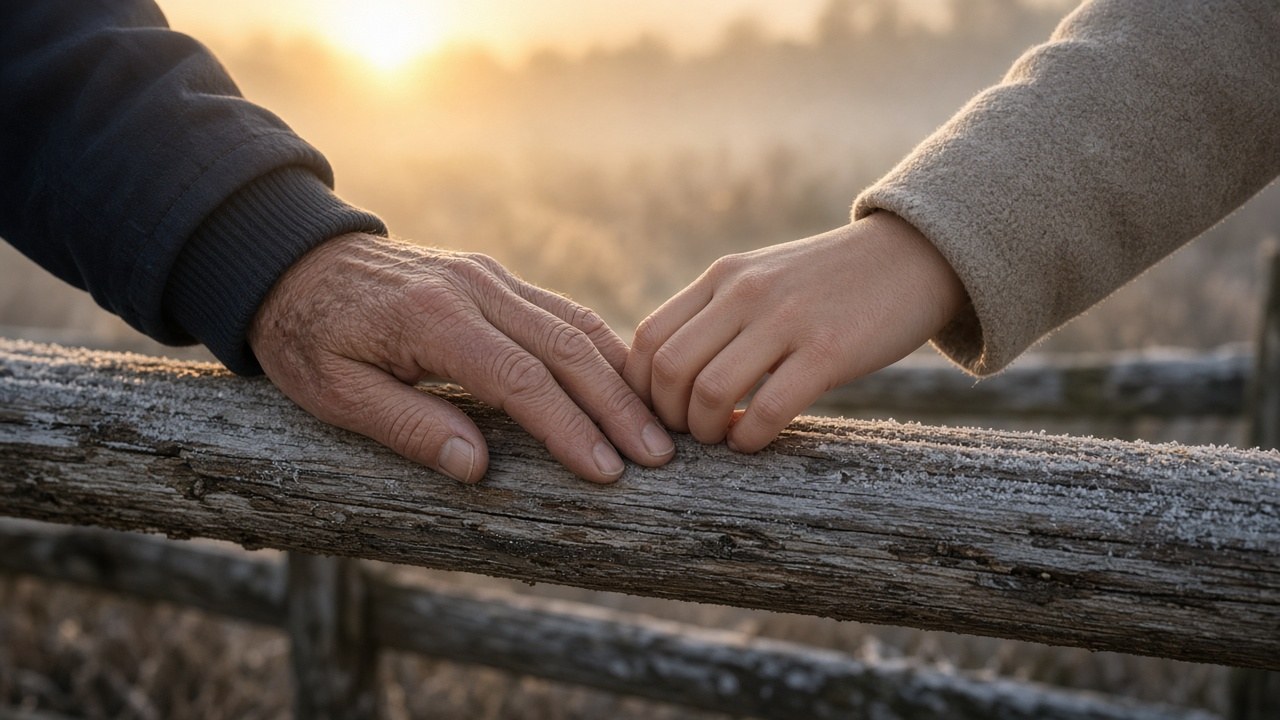
Then Vera held out her left hand. Not for a hug. Not yet.
Just her hand, with the crooked pinky.
Annie stared at it like she was scared it might disappear. Then she reached out and hooked her own crooked pinky around her daughter’s.
That was all. Two pinkies, on a frozen morning, at a cattle gate.
June started crying without making a single sound. Royce looked up at the sky and blinked hard.
I stood there in Grandpa Hank’s old barn coat with two hidden pages pressed against my back, and I thought, this is what Clay was protecting.
Not the land. Not the papers. This, right here.
Mill Street, Three in the Morning
It should have ended there. I wish with my whole heart it had.
But behind us, somebody cleared his throat.
It was Abel Haskins. He’d been so quiet by the van that I’d almost forgotten he was there.
“Cole,” he said. “You said that call came in a little after one.”
“That’s right.”
Abel rubbed his thumb over the little brass key, back and forth. “Then I need to say something. I should have said it a long time ago.”
Rita turned around. “Abel,” she said. “Don’t.”
It was the first time I had ever heard Rita Lane say a word that sounded scared.
“That same February,” Abel said, “I got a call at three in the morning. A lockout on Mill Street.”
“A woman locked out of her own house. Soaking wet to the waist. Shaking so hard she could barely stand up on the porch.”
“She told me she’d lost her keys in the creek.”
Nobody moved. The creek kept running under the ice, like it was listening too.
“I never asked her how,” Abel said. “You don’t ask questions at three in the morning. You open the door and you go home to bed.”
“But I write down every job in my books. Thirty years of them. Name, address, time, and what I charged.”
He looked right at Rita. “I charged you fifteen dollars. You paid me in cash, out of a wet wallet.”
Cole was already walking toward her. “Rita Lane,” he said. “Turn around for me.”
And Rita did the last thing I ever expected.
She didn’t run. She didn’t argue. She just looked past Cole’s shoulder and smiled at June.
“You opened the door, Abel,” she said, never taking her eyes off my grandmother. “But you never asked who was already sitting in my kitchen, waiting for me.”
June’s hand went cold in mine.
“Hank sat at my table until sunrise that night, June,” Rita said softly. “Drying my boots by the stove.”
“Ask yourself why your husband never told you.”
I looked down at the coat I was wearing. Hank’s coat. The one he wore to every cattle auction in this county.
And for the first time since I’d put it on, I wanted to take it off.
So now I’m asking you. Was Rita really the one behind the wheel that night, and did she leave a two-year-old in the water?
Why was Grandpa Hank sitting in Rita Lane’s kitchen at sunrise, and why did he never say a word to June?
And who asked Abel Haskins to open Cole’s desk drawer before Rita ever did?
Next Part: Lana’s Story Part 34 is coming soon. Follow Reiterin on Facebook so you don’t miss it.
Related Posts
 She Weighed as Much as a Newborn Hippo and Collapsed After a Few Steps. Now Peggy-Sue Races Into Rock Pools
 Lightning Struck Them Both on a Forest Trail. She Restarted His Heart Twice, Then He Asked Her to Marry Him
 Starving and Stuck in a Muddy Spillway, She Had No Way Out. Then a Microchip Revealed Someone Never Stopped Looking