Just finding Lana’s story? Read Part 22 here to catch up on Sheriff Cole Pruitt’s 2 AM visit, Clay’s original quitclaim, the planted name that cleared Vera, and the one phone call Rita Lane made from a holding cell.
Last time, Sheriff Cole Pruitt walked into June’s kitchen with Clay’s original quitclaim in a sealed evidence envelope and a second letter that named Rita Lane as the forger. Rita was pulled over on the highway with Willow’s papers and a blank quitclaim on the seat beside her. She got one phone call from a holding cell.
She used it on us.
“Tell Vera her real mother is still alive, baby. And she isn’t me.”
Then the line went dead.
The Photograph in the Lockbox
Nobody slept. I don’t think anybody even tried.
June put the coffee on at three, then again at four, and nobody drank either pot. The rain eased off to a drip from the gutters. Royce sat by the back door with his boots still on, like he expected to have to stand up fast. Nadine had her laptop open on the counter, typing and deleting, typing and deleting.
Vera sat across from me at June’s table and did not say one word for almost an hour.
I knew what she’d grown up believing, because she told me the first week we met. Her mother was a woman named Annie Kettering. Annie died in a car wreck on the county road when Vera was two. Clay raised her alone. There was one picture of Annie in Clay’s house, a blurry Polaroid on the fridge, and after Clay died somebody threw it out with the rest of his kitchen.
“Somebody,” Vera finally said, staring at her hands. “Rita cleaned that house out. Rita threw away the only picture I had.”
I reached for Clay’s lockbox. It was still sitting on the table where Abel had left it open. Under the notarized letter and the amendment was the faded photo we’d found the night before: young Rita and a twelve-year-old Deke at Clay’s kitchen table, practicing signatures.
Except there was a second photo stuck to the back of it.
I hadn’t seen it. None of us had. Eleven years of damp hayloft air had glued the two prints together, and when I slid my thumbnail between them, they peeled apart with a soft little tear.
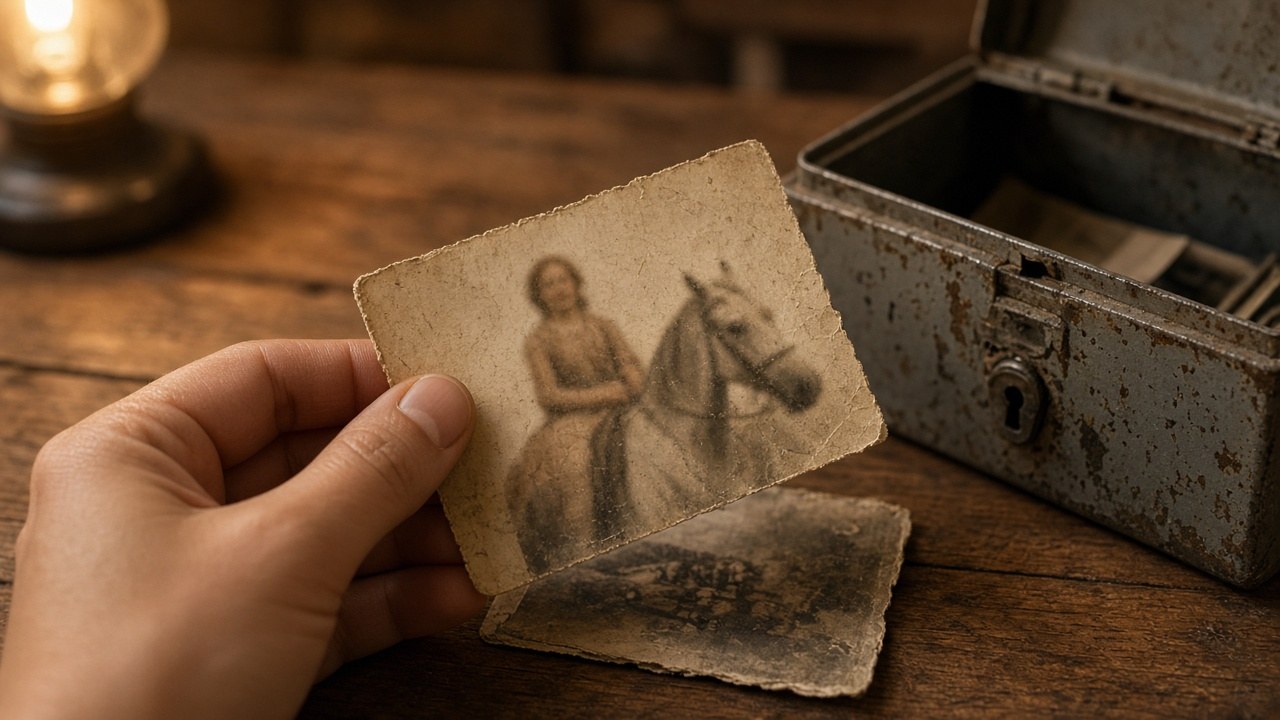
The second picture showed a woman on a gray horse. Long dark braid. Straw hat pushed back. Laughing at whoever held the camera. In the corner of the frame, a little girl with Vera’s exact chin sat on the top rail of a fence.
On the back, in Clay’s square handwriting: A.K. — Silver City. Don’t let her find out where.
No Death Certificate
Vera held that photo like it might burn her.
“That’s me,” she whispered. “That’s me on the fence. I don’t remember any of this.”
“You were maybe three,” June said quietly. “Maybe four.”
“She died when I was two.”
Nobody answered that, and the silence said everything.
Nadine turned her laptop around. “I can check this right now. County death records are digitized back to the seventies.” Her fingers flew. Then they stopped. She typed it again, slower. Then she looked up at Vera with the face clerks make when the paperwork says something nobody wants to hear.
“There’s no death certificate for an Annie Kettering. Not in this county. Not in the three counties around us. And there’s no accident report on the county road that year with that name.”
Vera stood up so fast her chair hit the wall.
“Then where is she?”
“Silver City,” I said, holding up the photo. “New Mexico. The same state as that decal on Rita’s tailgate.”
Royce let out a long breath. “Las Cruces is two and a half hours from Silver City.”
So Rita hadn’t just driven in from somewhere far away. She’d driven in from right next door to the woman Clay was hiding.
June’s Christmas Cards
June had gone very still at the stove.
I know my grandmother. I know the way she wipes her hands on a dish towel when she’s deciding whether to tell the truth. She was wiping them now. Hard.
“June,” I said.
“Don’t you look at me like that, Lana Brooks.”
“Then tell me why I’m looking at you like that.”
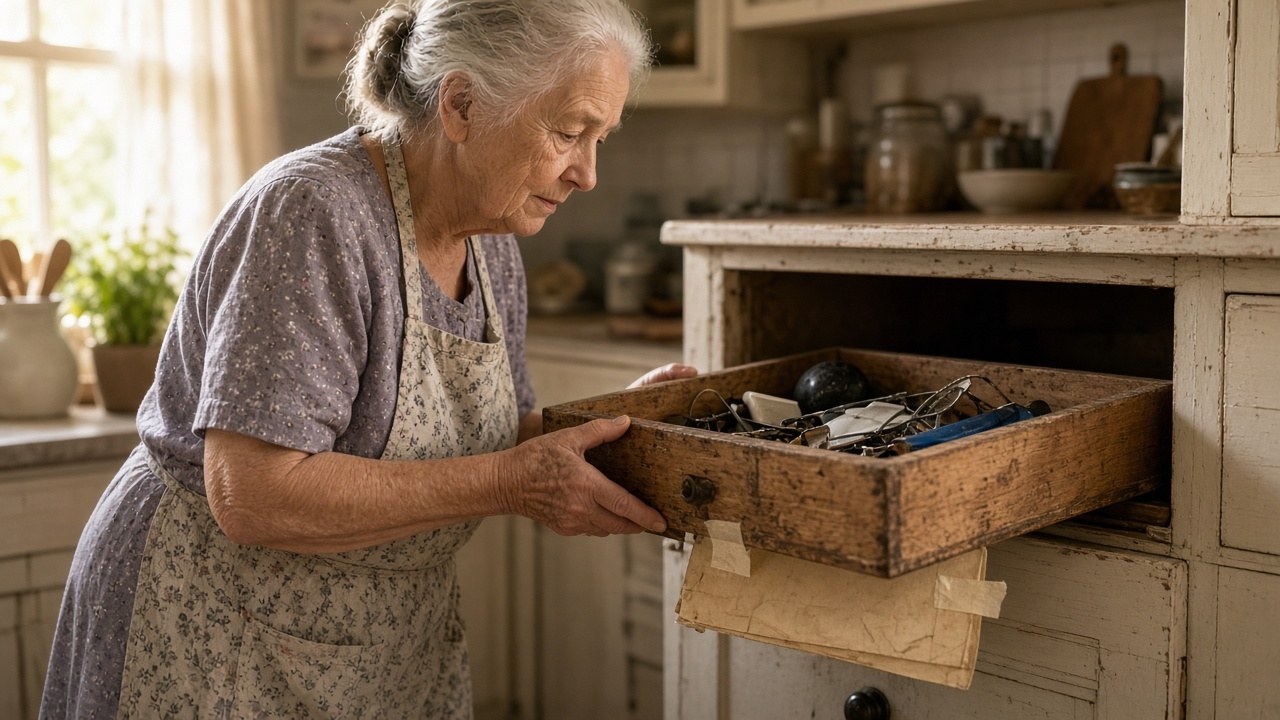
She set the towel down. She went to the junk drawer by the wall phone, the one full of rubber bands and dead batteries and recipe cards nobody has used since 1994, and she pulled the whole drawer out. Taped to the underside was a small envelope gone yellow at the edges.
“The winter before he died, Clay sat out in Hank’s barn every night for a week,” June said. “I told you that. What I didn’t tell you is that on the last night he came in here and asked me for one favor. He gave me a post office box number in Silver City and two hundred dollars in cash. He said, ‘June, every Christmas, mail a card to this box. Don’t sign your name. Just put a picture of the girl inside.'”
Vera made a sound I will never forget.
“The girl,” June said, looking right at her. “You, honey. Every Christmas for eleven years, I’ve cut your picture out of the church bulletin or the county fair paper and mailed it to a box in New Mexico. I never knew who got them. Clay made me promise not to ask.”
“And you never once thought to tell me?”
“I thought it was a cousin. An old girlfriend. Something he was ashamed of.” June’s voice cracked. “I didn’t know it was your mama. I swear on Hank’s grave I didn’t know.”
The Card That Came Back
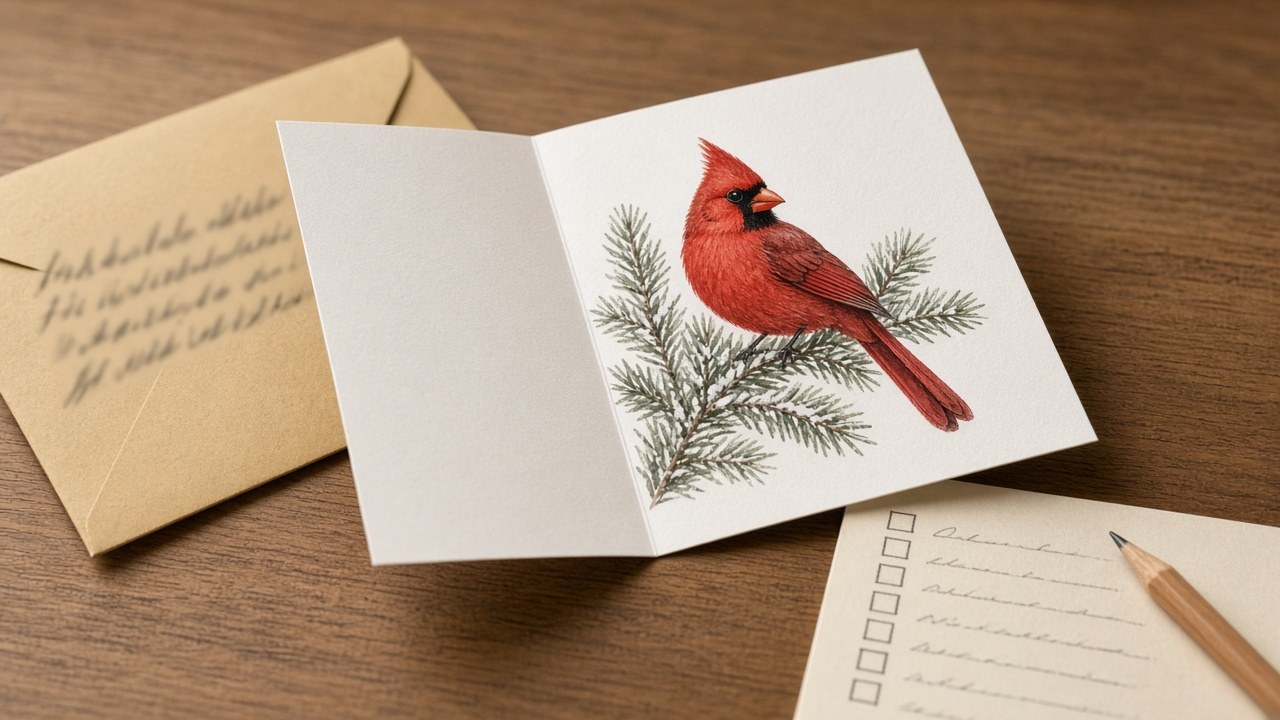
Inside the yellowed envelope were three things. A post office box receipt. A list of the eleven years June had mailed a card, each one checked off in pencil. And a single Christmas card that had been mailed back.
It wasn’t one of June’s. It was a plain white card with a cardinal on the front, postmarked Silver City, New Mexico, last December.
“It came addressed to me,” June said. “No return name. I almost threw it away. I read it once and I hid it, because I didn’t understand it, and because I was afraid of what it meant.”
Vera opened it with shaking fingers.
The handwriting was small and slanted and nothing like Clay’s.
Thank you for every picture. She has his stubborn chin and my hands. Please don’t stop. And please, if Rita ever comes back to that county, don’t let her near my girl. — A.
Vera read it three times. Then she sat down on the floor of June’s kitchen, right there by the stove, with her back against the cabinets, and she cried the way you cry when twenty-five years of a story fall apart at once.
I sat down beside her. I didn’t say anything. There wasn’t anything to say. I just let her lean on me while Willow nickered from the barn like she knew something was wrong.
Gone Before Sunrise
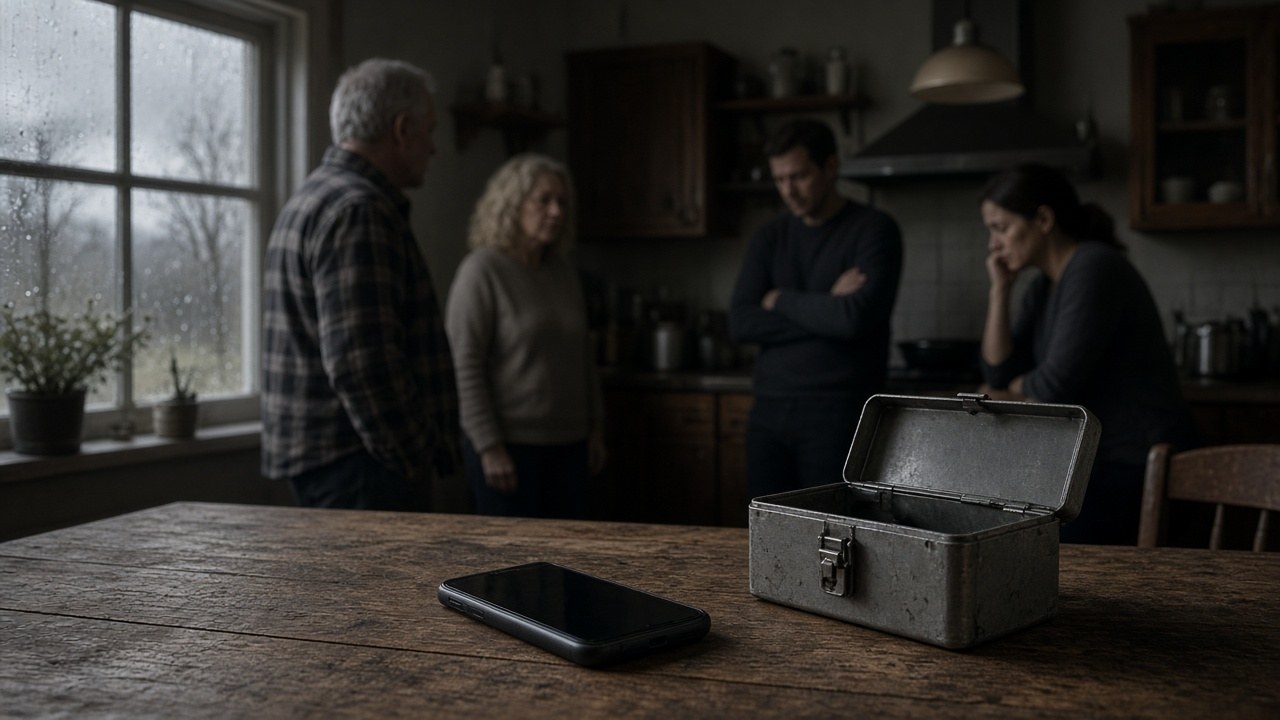
The sky was going gray when Cole Pruitt called back.
June put him on speaker. He sounded like a man who’d been awake as long as we had.
“Miss Brooks. I need everybody in that kitchen to stay calm.”
My stomach dropped. “Where’s Rita?”
“That’s why I’m calling. At five-fifteen this morning, somebody walked into the county jail and posted her bond in cash. All of it. Rita walked out the side door eleven minutes later.”
“Who?” Vera said from the floor. “Who would pay for her?”
Cole was quiet for a second too long.
“The woman signed the bond paperwork herself. Showed a New Mexico driver’s license. Ma’am, I’m sorry to be the one telling you this over the phone.” He cleared his throat. “The name on the bond is Annie Kettering.”
Vera’s head came up.
The mother who was supposed to be dead. The mother who begged June to keep Rita away from her girl. The mother who wrote don’t let her near my girl.
She had just driven into our county and set Rita Lane free.
So now I’m asking you. Why would Annie Kettering bail out the one woman she warned us about? Is the woman with that driver’s license really Vera’s mother, or is somebody using a dead woman’s name? And if Annie is alive and in our county right now, why hasn’t she come to see her daughter?
Part 24 is coming soon. Follow Reiterin on Facebook so you don’t miss what happens next.
Related Posts
 Their Mom Was Hit by a Car With Her Babies Still on Her Back. All Six Survivors Just Went Home to the Wild
 A Driver Hit His Grandma During Their Bike Ride. This 6-Year-Old Knew Exactly What to Do
 Lana’s Story Part 24: The Woman at the End of the Lane
 Deputies Dug Into the Dirt and Heard Tiny Cries. Two Buried Kittens Are Now ‘Living Miracles’
 She Saw an 85-Year-Old Theater Worker Pushing a Trash Cart. Strangers Raised $146,000 in Two Days
 Crews Freed a Metchosin Sea Lion After a Rubber Band Cut Into His Neck for a Year