Just finding Lana’s story? Read Part 40 here to catch up on who stepped out of Wade’s white Ford and the little brown book from the glovebox.
Last time, a pair of high beams came up the old rail line, where there isn’t supposed to be a road at all.
The man who stepped out of Wade Pruitt’s white Ford was Deke. Nadine’s son. The boy who ran from Royce out of our hayloft.
He’d kept his dead daddy’s truck running in a pole barn behind the rail line since spring.
And he brought Wade’s little brown tally book, the one that sat in the glovebox for twelve years.
The Thursday page said Wade followed Rita’s car the night before my mother died. With Nadine driving.
Then Cole came over the rise with his lights spinning. And he turned the page to Friday. The day my mother died.
Wade hadn’t written a thing on it. But Clay had. Four lines, in his heavy, slanted hand.
The first one said: “Roy. If you ever find this book, I need you to know it wasn’t Wade.”
Cole read the last line. Then he closed the book and looked straight at me. And he didn’t say a word.
Four Lines in Clay’s Hand
Nobody moved. The wind kept banging a loose sheet of tin up on the elevator, like somebody knocking to be let in.
Cole stood there with the book shut on his thumb. His face was the color of the gravel.
“Cole,” I said. “What does it say?”
He didn’t answer me. He turned and held the book out to Royce.
“It’s got your name on it,” Cole said. “First word. It’s yours to read, not mine.”
Royce looked at that little book like it might bite him. Then he handed me Hank’s flashlight and took it with both hands.
I held the light. Royce opened it to Friday and bent his head close.
Clay’s handwriting filled the middle of the page. Pressed so hard the pencil had nearly gone through.
Royce read the first line again, out loud, slow. “Roy. If you ever find this book, I need you to know it wasn’t Wade.”
Then he read the second line.
“Wade came to my kitchen before daylight. He said he would not go where Daddy was sending him today.”
Nadine made a sound like she’d been hit. Deke put his arm around her shoulders.
Royce cleared his throat and read the third line.
“So I took his truck and went myself. To get Caroline out of this county before Daddy could get to her.”
My knees went soft. I had to lock them to keep the light steady.
Clay. It was Clay in Wade’s white Ford that Friday. Not Wade.
Royce lowered the book. He looked up at the dark, at nothing, the way he does when a horse throws him and he’s waiting to see what’s broken.
“That’s what he meant,” he said. “All those years. Tell Roy I’m sorry I was the one who stayed.”
“He stayed so he could do this,” Royce said. “So he could climb in another man’s truck and go get my girl.”
“And I was in Oklahoma. Teaching other people’s colts to trust a hand.”
I wanted to tell him it wasn’t his fault. But I’d learned that the hard way this month. You can’t hand somebody that. They have to pick it up themselves.
Royce looked back down at the page. And he didn’t read the fourth line. He just stood there, staring at it, his lips moving with no sound coming out.
“Royce,” I said. “The last one.”
“I can’t, sweetheart,” he whispered. “Give me a minute. I just can’t yet.”
Cole’s radio crackled on his shoulder. Somebody back in town asking for his location.
He reached up and switched it off. I’d never once seen him do that.
“Not yet,” he said to nobody. “Not yet.”
Where Wade Went on Friday
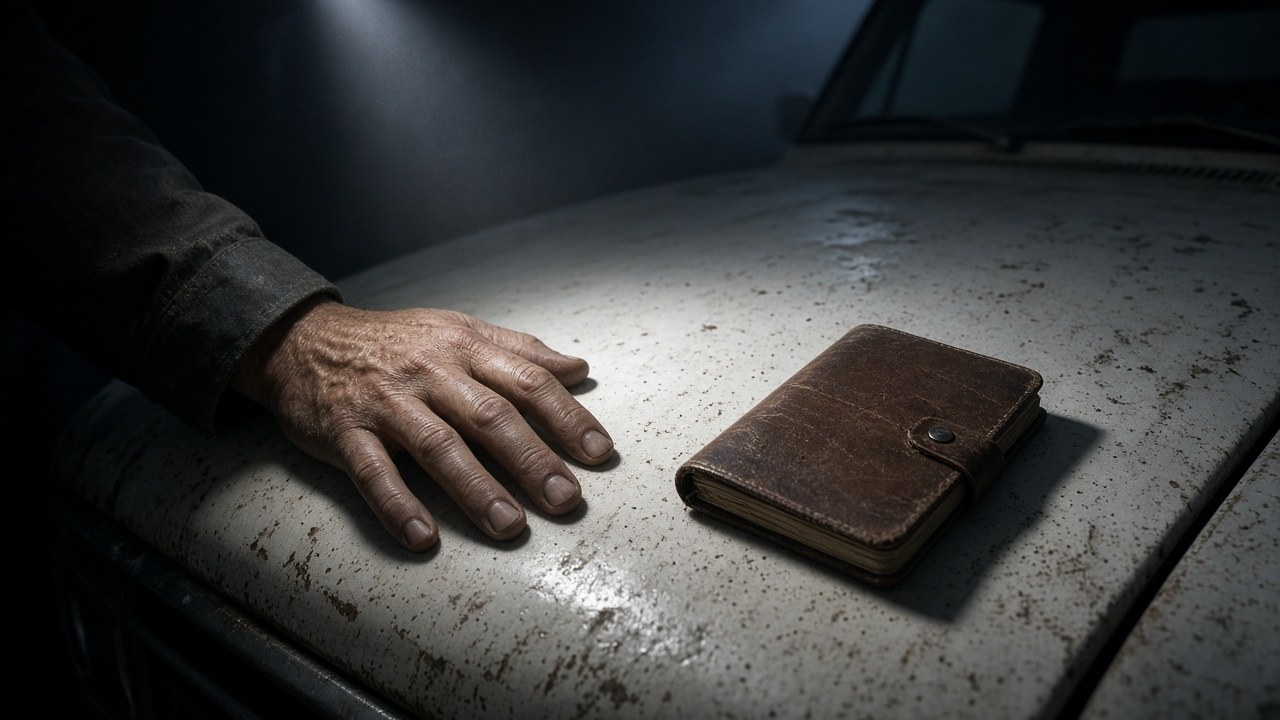
Nadine pulled away from Deke and walked straight up to the truck. She laid her palm flat on that chalky white hood.
“He told me to stay in the house,” she said. “He told me not to answer the phone. And I thought he was going to do something terrible.”
“Twenty-five years, I thought my husband did something terrible that day. And I married him anyway. And I stayed.”
“Mama,” Deke said softly.
“He wasn’t out doing the old man’s work,” she said. “He was sitting in Clay Kettering’s kitchen. Waiting on his own truck.”
I thought about what she’d told me. Wade came home after dark. Sat out in this truck for an hour with the engine off.
“He was reading it,” I said. “That night. Sitting out there with the dome light on. He was reading what Clay wrote.”
Nadine looked at me. Then she nodded, very slowly.
“And he never told me,” she said. “Not one word. Not in thirteen years of marriage.”
“Maybe he figured you’d be safer not knowing,” Royce said quietly. “That’s how my family did everything. Safer not knowing.”
“It wasn’t safer,” Nadine said. “It was just lonelier.”
Royce looked at the truck. “Clay never could drive a stick worth a nickel,” he said. “He’d have ground every gear in it.”
“He did,” Nadine said. A laugh came out of her that was half a sob. “Wade complained about that clutch for a month. I never knew why.”
Deke looked at the ground. I thought about him in that pole barn, reading this book by a work light all spring. All by himself.
“Why didn’t you show your mama?” I asked him.
“Because she’d have burned it,” he said. “She’d have burned it to keep Uncle Cole’s name out of it.”
And there it was. The thing nobody had said out loud yet.
The Boy at the Co-op Scale
Cole had been quiet so long I’d almost forgotten he could talk. Now he turned around.
“My name,” he said. “Go on, Deke. Say it all. My name’s in that book too. Isn’t it?”
Deke didn’t answer. He didn’t have to. Royce turned two pages back and held them up into my light.
Two Friday loads. And next to each one, in a young man’s hand, the letters C.P.
I had a choice to make right then. I could keep Clay’s second page to myself. The page still sitting under the Bible on his kitchen table.
Or I could stop carrying things for people who never asked me to.
“Clay wrote about it too,” I said. “On the second page of his letter. The part I didn’t let you read.”
“He wrote that those cattle weren’t Kettering cattle. And that your name was on the weigh tickets. In your own hand.”
Nadine closed her eyes. Deke swore under his breath.
Cole just nodded. Like a man hearing the weather report for a storm he’d already been standing in.
“I know,” he said.
“You know?”
“I was twenty-two,” Cole said. “I pumped gas at the co-op. On Friday nights, I ran the cattle scale out back too.”
“Wade’s trailers came in after dark. I weighed them. I signed the tickets. C.P. on every one. It was my job.”
“He bought me lunch every Friday that whole year,” he said. “Cheeseburger and a root beer. I thought it was because he was proud of me.”
His voice didn’t shake. That was the worst part. It sounded like he’d said it to himself a thousand times.
“I figured it out about three years after I got my badge,” Cole said. “Pulled an old brand report. Saw the dates. Knew what I’d signed.”
“I’ve carried that for twenty years, Lana. I never told a soul. Not Nadine. Not anybody.”
“Clay knew,” I said. “He wrote it down so somebody would get you clear of it. He said you were a good boy. He said you didn’t know.”
“I didn’t,” Cole said. “Not then. But I’ve known every day since.”
Nadine grabbed his sleeve. “Don’t you turn yourself in, Cole Pruitt. Don’t you dare. You were a kid.”
Cole looked down at her hand on his arm. Then he looked at the white Ford.
“Read me the last line, Mr. Royce,” he said. “Then we’ll talk about what I’m going to do.”
Under the Seat
Royce lifted the book back into the light. His hand was steadier now. He read it straight through.
“If I don’t reach her in time, everything Caroline trusted me with is under the seat of this truck. Give it to her baby girl.”
Nobody breathed.
Even the tin up on the elevator quit banging, like the wind had stopped to listen.
Her baby girl. Twenty-five years ago, that was me. A baby who didn’t know her mother’s face yet, and never would.
I remembered the Thursday page. Envelope went under the seat. I’d thought Wade meant Rita’s car.
He didn’t. Somebody put an envelope under the seat of this truck. And Clay knew it was there.
“Deke,” I said. My voice came out strange. “You’ve had this book since spring. You read that line a hundred times.”
“Yes, ma’am.”
“Did you look?”
He didn’t answer right away. He walked around to the driver’s side and opened the door.
The cab light came on, yellow and weak. The bench seat was split and patched with gray duct tape.
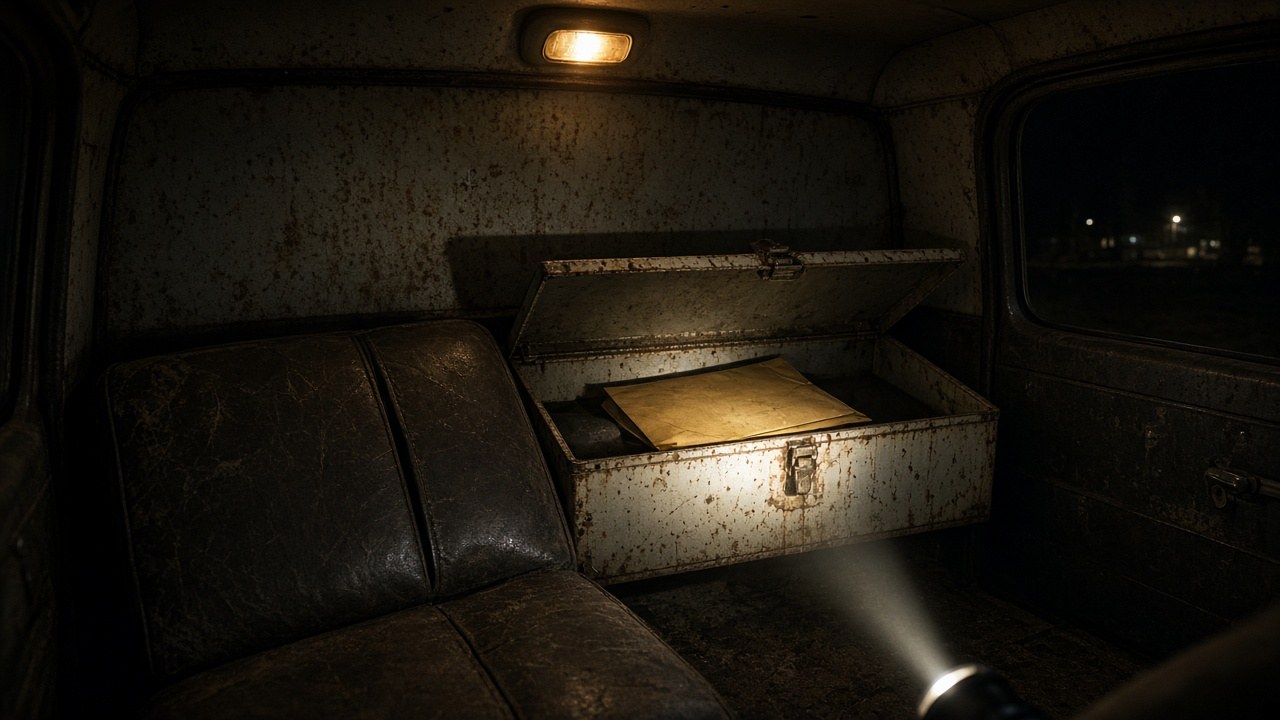
Deke reached down and pulled a lever I couldn’t see. The whole seat back folded forward with a groan.
Behind it, bolted to the back wall of the cab, was a flat steel toolbox. Painted white like the truck, so you’d never notice it.
“Took me two weekends to find,” Deke said. “And a whole can of WD-40 to get that lid open.”
“I found what was in it. But I never opened what I found. It isn’t mine.”
“It’s got your name on it, Lana,” he said. “That’s why I came tonight. That’s why I’ve been watching your family.”
“I was trying to figure out if you were somebody my daddy would’ve trusted with it.”
I thought about every time I’d felt eyes on me this fall. The loft window. The tree line. June’s henhouse at dawn.
All that time, I thought somebody was hunting us. It was a boy trying to decide if we were safe.
“You could’ve just knocked on the door,” I said.
“On the sheriff’s sister-in-law’s door? With my daddy’s name?” Deke almost smiled. “No, ma’am. I couldn’t.”
He lifted the steel lid. It screeched so loud June probably heard it back at Clay’s.
Inside was an envelope. Big and yellowed. Soft at the corners from twenty-five years of heat and cold.
Deke held it out to me. I couldn’t make my hands work. Royce had to take the flashlight back from me.
My Name in My Mother’s Hand
The envelope was heavier than it looked. Something stiff was inside. And something small and hard, sliding in the bottom corner.
I turned it over in the light.
I’d only ever seen my mother’s handwriting on the letter she wrote to Clay. I’d read it so many times I could see it with my eyes shut.
Round and quick and leaning forward, like it was in a hurry to get somewhere.
Across the front of that envelope, it said one word.
“Lana.”
Just my name. Written by the one person who picked it, twenty-five years before I ever got to stand here and read it.
My whole life, people have told me who my mother was. Ruth. June. Rita. Royce. Now she was telling me herself.
“Oh, honey,” Nadine whispered.
Royce put his hand on my back. I could feel it shaking right through my coat.
Under my name, smaller, she’d written something else.
“If you’re reading this, Uncle Clay kept his promise. Don’t let anyone open it before you do.”
Somewhere back toward town, a dog started barking. Then another. Then it was quiet again.
Cole took one step toward me. Then he stopped himself.
“That’s evidence, Lana,” he said quietly. “Whatever’s in there. You know I have to say that.”
“I know,” I said.
“And you know I’m not going to take it from you.”
“I know that too.”
I slid my thumb under the flap. The old glue gave way like it had just been waiting.
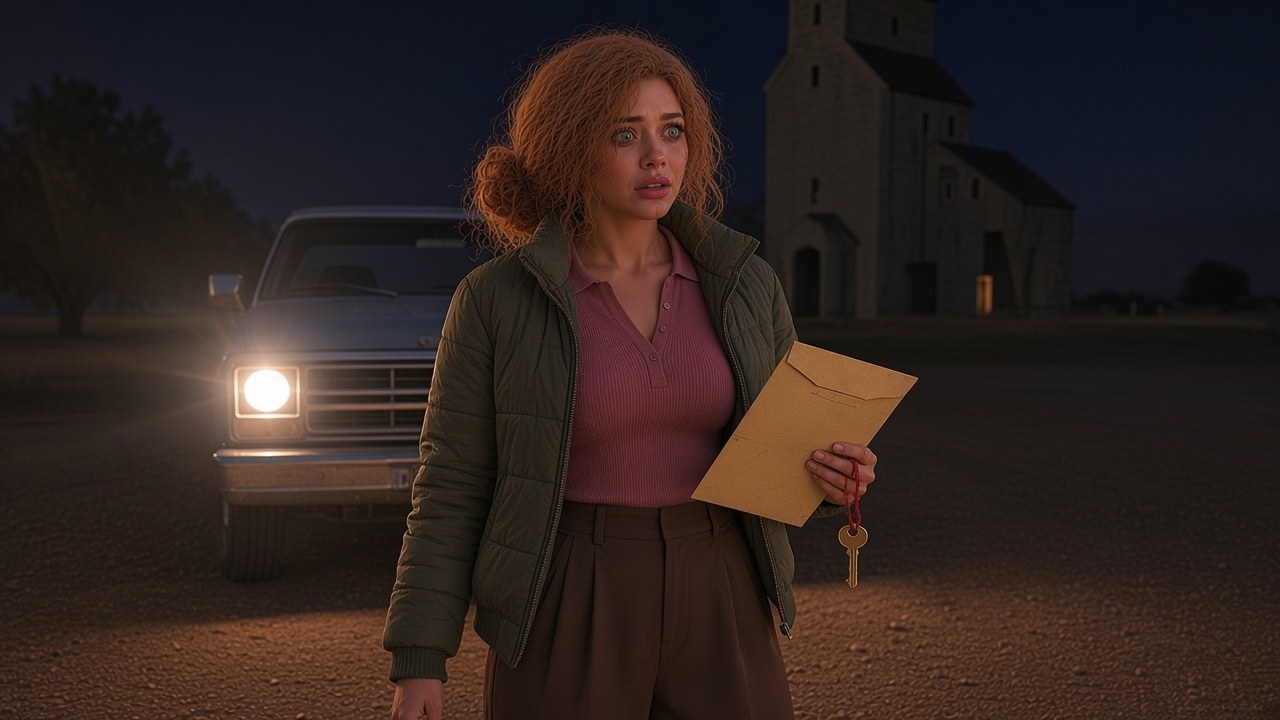
The small hard thing slid out first and dropped into my palm. It was a key. Brass, with a paper tag tied on with red string.
The tag said, in my mother’s hand: “Box 14.”
Box 14. I didn’t know of a single box in this county with a number on it. Not a mailbox. Not a post office box. Not a bank.
“Royce,” I said. “Does that mean anything to you?”
He shook his head. Cole shook his. But Nadine had gone dead still, staring at that red string.
Then I pulled out the folded paper. And the very first line made Royce drop the flashlight in the gravel.
So now I’m asking you. Did you ever think it might be Clay, not Wade, behind the wheel of that white Ford?
Should Cole turn himself in for signing those weigh tickets when he was twenty-two? Or has he carried it long enough?
And why do you think Nadine went so still when she saw that key? What do you think “Box 14” opens?
Next Part: Read Lana’s Story Part 42 here Follow Reiterin on Facebook so you don’t miss it.