Just finding Lana’s story? Read Part 33 here to catch up on the little girl in the back seat, who was really driving that night, and the 3 a.m. call on Mill Street.
Last time, Sheriff Cole Pruitt finally admitted the truth. Twenty-three years ago, there was a little girl in the back seat of that car.
It was Vera. He broke the window with his flashlight and carried her up the creek bank inside his jacket.
Then Annie told us who was really behind the wheel that night. Her own sister. Rita Lane.
Cole remembered small boot prints on the far bank. Abel Haskins remembered a soaking-wet woman on Mill Street at three in the morning, paying him fifteen dollars from a wet wallet.
Cole said, “Rita Lane. Turn around for me.”
And Rita just smiled at June.
“Hank sat at my table until sunrise that night, June,” she said. “Drying my boots by the stove. Ask yourself why your husband never told you.”
Keep the Coat On
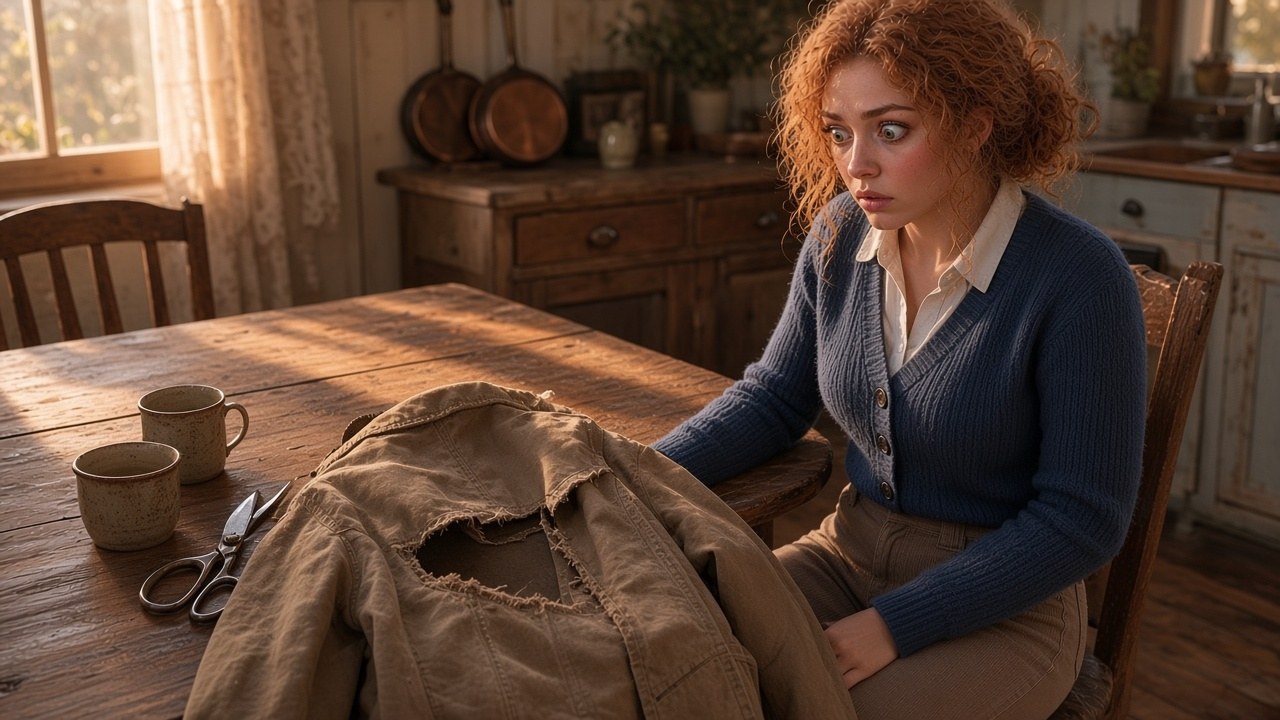
I had my fingers on the top button of Hank’s coat before I even knew I was doing it.
I didn’t want it on me anymore. Not if Rita’s words were sitting inside it.
June’s hand closed over mine. Her fingers were ice cold, but they didn’t shake.
“Leave it on, honey,” she said quietly. “Hank’s coat never did a thing wrong in its life.”
Then she let go of me and turned to face Rita across the frozen gate.
I expected her to cry. Or yell. June Whitaker can yell loud enough to turn a runaway horse.
She did neither. She just looked at Rita the way she looks at a fence post that’s leaning, deciding where to push.
“I remember that night,” June said.
Rita’s eyebrows went up. She hadn’t expected that either.
“February. Cold enough to freeze the water trough solid,” June said. “Hank went out after supper and didn’t come home.”
“He came in the kitchen door after the sun was up. His boots were soaked through, and he smelled like somebody else’s woodstove.”
“I asked him where he’d been all night. He said the Mercer place. Said they had a heifer having trouble calving.”
She took a slow breath. Her breath hung in the air like smoke.
“I believed him,” she said. “I believed every word that man ever said to me.”
“Then you were a fool for a long, long time,” Rita said. Soft as a church hymn.
Cole took one step toward her. June held up her hand without even looking at him.
“Maybe,” June said. “But Hank sat up with sick animals his whole life, Rita. Every cow and colt in this valley.”
“If he sat up all night at your table, I’d bet my farm he wasn’t there for you. He was there for whatever you’d done.”
For one second, just one, Rita’s smile slipped.
I saw it. I think we all saw it.
One Headlight
It was Annie who broke the quiet.
“The Mercer place,” she said slowly. She was staring up the hill like she could still see it in the dark.
“That’s where Clay ran to call it in. Their porch light was on. I remember thinking it was the only light for a mile.”
“And when Clay came back down, a truck pulled out of the Mercer drive behind him. It didn’t turn toward the creek. It turned toward town.”
Cole had gone very still.
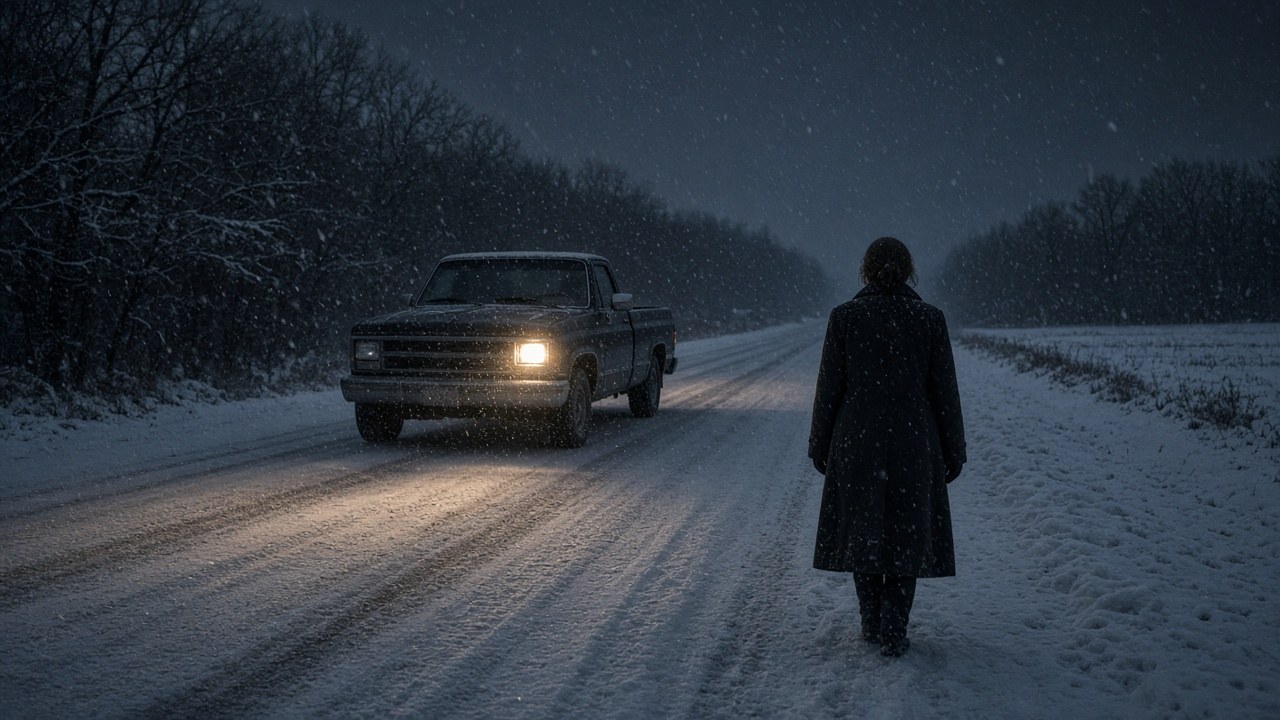
“I passed a truck,” he said. “Driving out to the crossing that night. Old pickup, heading toward town, maybe two miles from the creek.”
“I only noticed because it had one headlight out. I almost pulled it over for that. Then I figured I had bigger trouble ahead of me.”
June made a small sound in her throat.
“Hank’s truck had one headlight out that whole winter,” she said. “He kept telling me he’d fix it Saturday. Every Saturday.”
Nobody said anything after that. The creek kept muttering under the ice.
I kept thinking about that road. A woman walking toward town in the snow, soaked to the waist. And a truck with one light, passing her by.
“He saw you,” I said to Rita. “On the road. He drove right past you.”
“He did,” Rita said. She sounded almost proud of it. “Didn’t even slow down. I thought, well, there’s a man minding his own business.”
“Then I got home and couldn’t get in. My keys were at the bottom of that creek.”
“And my spare wasn’t under Mama’s old milk can on the porch, where it had been since I was a girl.”
She looked at Abel. “So I walked to the pay phone at the corner, and I called the only locksmith in the county.”
“You opened my front door,” she said. “And Hank was sitting at my kitchen table in the dark.”
“My spare key was lying on the table in front of him.”
Abel’s face went gray. He looked down at the little brass key in his hand like it had bitten him.
I felt it then. Something clicking into place, like a gate latch.
“He took the key on purpose,” I said. “So you’d have to call somebody. So there’d be a witness.”
“So somebody would write it down.”
Abel lowered himself onto the bumper of his van, slow, like his knees had quit on him.
“Thirty years I’ve kept those books,” he said. “I never once thought somebody might be counting on me to.”
What Rita Wrote by the Stove
Rita looked at all of us like we were a crowd at a county fair, waiting for the next ride.
“You want the rest?” she said. “Fine. Hank sat there and didn’t say one word for an hour.”
“He hung my boots by the stove. He made coffee in my own kitchen. Then he set a pencil and a sheet of paper in front of me.”
“He said, ‘Write down who was driving that car tonight. Every bit of it. Or I drive you to the sheriff right now, the way you are.'”
“So I wrote.”
Vera’s hand found mine. Her fingers were trembling.
“When the sun came up, he folded that paper and put it inside his coat,” Rita said. “And he made me a promise.”
“He said as long as I never went near that baby, the paper stayed folded. The day I did, the whole county would read it.”
She turned and looked straight at Vera for the first time all morning.
“Twenty-three years I stayed away from you, sugar. Not because of Cole’s promise. Cole couldn’t have stopped me.”
“Hank’s paper did.”
Annie put her hand over her mouth. I don’t think she had ever known.
All those years she spent hiding in Silver City, she thought it was Clay keeping Rita away. Clay and Cole.
It was a man who barely knew her. A man who sat up all night with a problem that wasn’t even his.
“Hank died,” Rita went on. “Clay died. And nobody ever found that paper.”
“Hank told me he’d keep it where nobody would ever think to look. I’ve spent a lot of years wondering where that might be.”
Then she smiled at me. At the coat.
And suddenly I understood what she’d really been looking for all those weeks.
Not the land. Not Clay’s folder. Not the twelfth page.
A piece of paper with her own handwriting on it.
Cole had heard enough. He pulled the cuffs off his belt.
“Rita Lane, I’m placing you under arrest,” he said. “For breaking into my desk at the sheriff’s office.”
Rita laughed. “For a twenty-three-year-old accident report?”
“For two weeks ago,” Cole said. “That one’s not old at all.”
He looked over at the van. “Abel. You opened that drawer for her.”
“I did,” Abel said. He didn’t even try to argue. “She asked me to. I should’ve said no.”
“We’ll talk about you later,” Cole said. “Don’t leave the county.”
Rita didn’t fight him. She held her wrists out like she was being handed a corsage.
But as Cole walked her toward his car, she twisted around one last time.
“Hank sewed a whole lot better than you ever did, June,” she called. “Did you know that?”
Then the car door shut, and she was gone.
June’s Table
We drove back to June’s place in a line. Royce’s blue Chevy, then Abel’s van, then June and me and Willow at a walk across the creek field.
Nobody said much. I think we were all too tired to talk.
June put the coffee on before she even took her boots off. That’s how I knew she was going to be okay.
Royce found the biscuit tin without being asked. Abel sat by the door with his hat in his lap, like he wasn’t sure he was still welcome.
June poured him the first cup. That settled that.
Then Annie sat down at June’s table. Vera sat across from her.
Annie had promised to tell her daughter everything, today, at this table. And she did.
It took almost two hours.
She told Vera about the year she was born. About the porch swing at Clay’s house, and how Vera used to fall asleep on it every single afternoon.
She told her about Rita’s threats, and the night Rita took her, and the cold water, and the back door that wouldn’t open.
She told her about Silver City. The Christmas cards. Every single picture June ever mailed, and how she kept them in a shoebox under her bed.
“I watched you grow up in church bulletins,” Annie said. “I know what you wore to your eighth-grade dance.”
Vera laughed. It came out wet and surprised, like she hadn’t meant to.
“The green dress,” she said.
“The green dress,” Annie said. “With the sleeves you hated.”
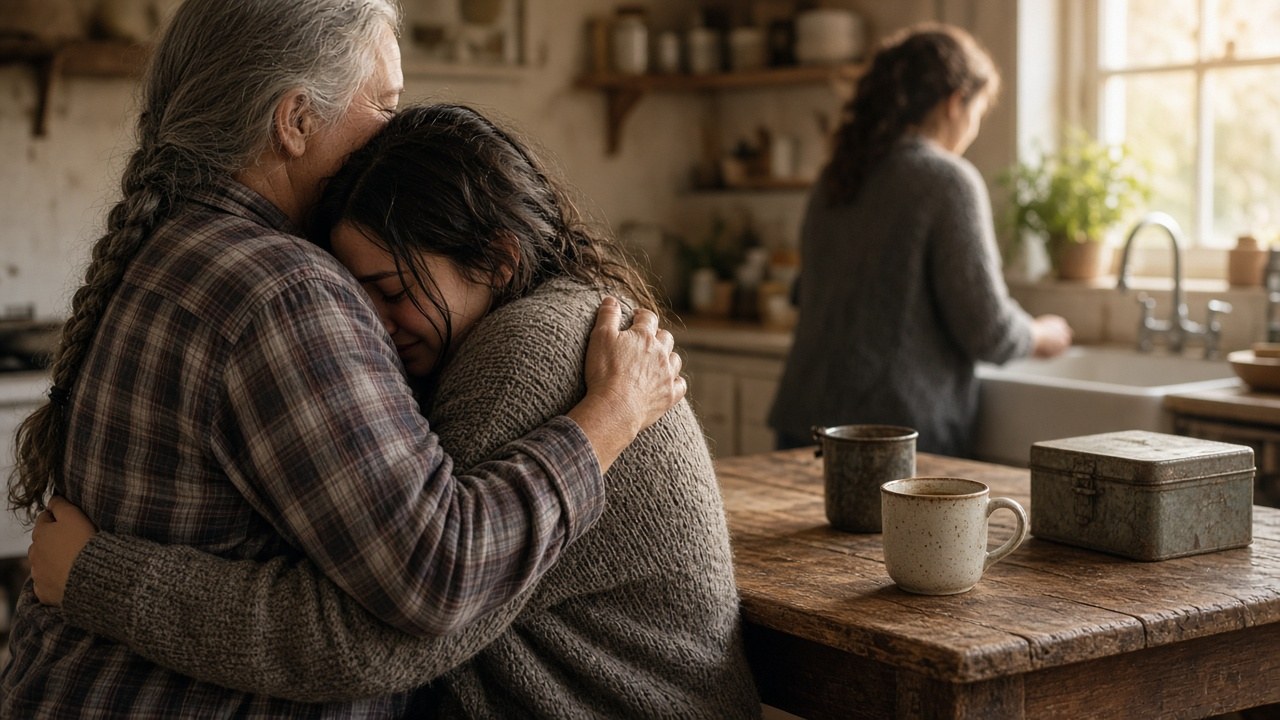
And then Vera stood up, walked around the table, and put her arms around her mother.
Just like that. Twenty-three years, and it took about four steps.
Annie made a sound I will never forget as long as I live. Like something that had been locked up for a long time finally getting out.
June turned to the sink so nobody would see her face. Royce found something very interesting to look at out the window.
I just stood there and let myself cry.
Hank’s coat was heavy on my shoulders. For the first time all morning, it didn’t feel like a stranger’s.
Hank’s Stitches
When the coffee was gone, June looked at me. “Take it off now, honey,” she said. “Let’s get those pages out of there.”
I slid the barn coat off and laid it face-down across the kitchen table. June reached into the torn lining near the hem.
Out came Clay’s note. Then the twelfth page. Both flat and dry, exactly where she’d tucked them.
“There,” she said. “Now we put those somewhere safe.”
But she didn’t move. Her hands had stopped on the back of the coat, right between the shoulders.
“June?”
She pressed down with her palm. Then with her fingertips. Then she turned the coat over and folded back the collar.
There was a seam there, across the inside of the back. Small, tight stitches in heavy brown thread.
“That’s not my stitching,” June whispered.
“I patched this coat a dozen times. I never sewed that.”
She ran her thumb along it. Her voice went thin. “That’s Hank’s. He sewed like he was fixing a bridle. Waxed thread. Every stitch the same.”
Under that seam, something flat and stiff was pressed against the canvas. About the size of a postcard.
It had been there the whole time. On my back. At the gate, in the frost, while Rita stood ten feet away smiling at me.
Vera got June’s sewing scissors out of the drawer and handed them to her. June’s hands were shaking too hard. She handed them to me.
I cut the first stitch. Then the next one. The thread was so old it creaked.
Inside was a square of oilcloth, folded tight like a letter. Somebody had wanted it to stay dry for a very long time.
I unfolded it on the table. There was an envelope inside, yellow as an old tooth.
On the front, in big square pencil letters, it said: JUNE. ONLY IF RITA EVER SAYS MY NAME.
June sat down very slowly.
“Today,” she said. “She said it today.”
The envelope wasn’t sealed. When I lifted the flap, something small and soft slid out onto the table.
It was a mitten. A tiny child’s mitten, flattened from all those years under the stitches.
It had been red once. Now it was faded almost to pink, with a little white snowflake knitted on the cuff.
Vera stopped breathing beside me.
I heard Cole’s voice in my head, from that morning at the gate. One of them came off in the water. I always wondered if anybody ever found it.
Somebody had. And Hank had carried it home on his back.
“It was in her coat pocket,” Annie whispered. “Rita’s. It had to be. She must have pulled it off you in the car.”
Vera reached out with one finger and touched it, so gently, like it might fall apart.
There was one more thing in the envelope. A single sheet of paper, folded in thirds, soft as cloth.
The handwriting was a woman’s. Neat and slanted, written in pencil. The kind of handwriting that gets compliments at church.
I knew it before I read a word. I’d seen it on the twelfth page.
It started: Hank, you want to know who was driving that car tonight. I’ll tell you. But you’re not going to like the name.
I read the next line. Then I read it again.
And then I looked up at the woman sitting across June’s table from me, and I couldn’t make my mouth say anything at all.
So now I’m asking you. Why did Grandpa Hank sew that red mitten and Rita’s confession into his own coat instead of handing them to the sheriff?
If Rita was the one behind the wheel, why would she write that Hank wasn’t going to like the name?
And who at June’s kitchen table do you think Lana is looking at right now?
Next Part: Read Lana’s Story Part 35 here Follow Reiterin on Facebook so you don’t miss it.