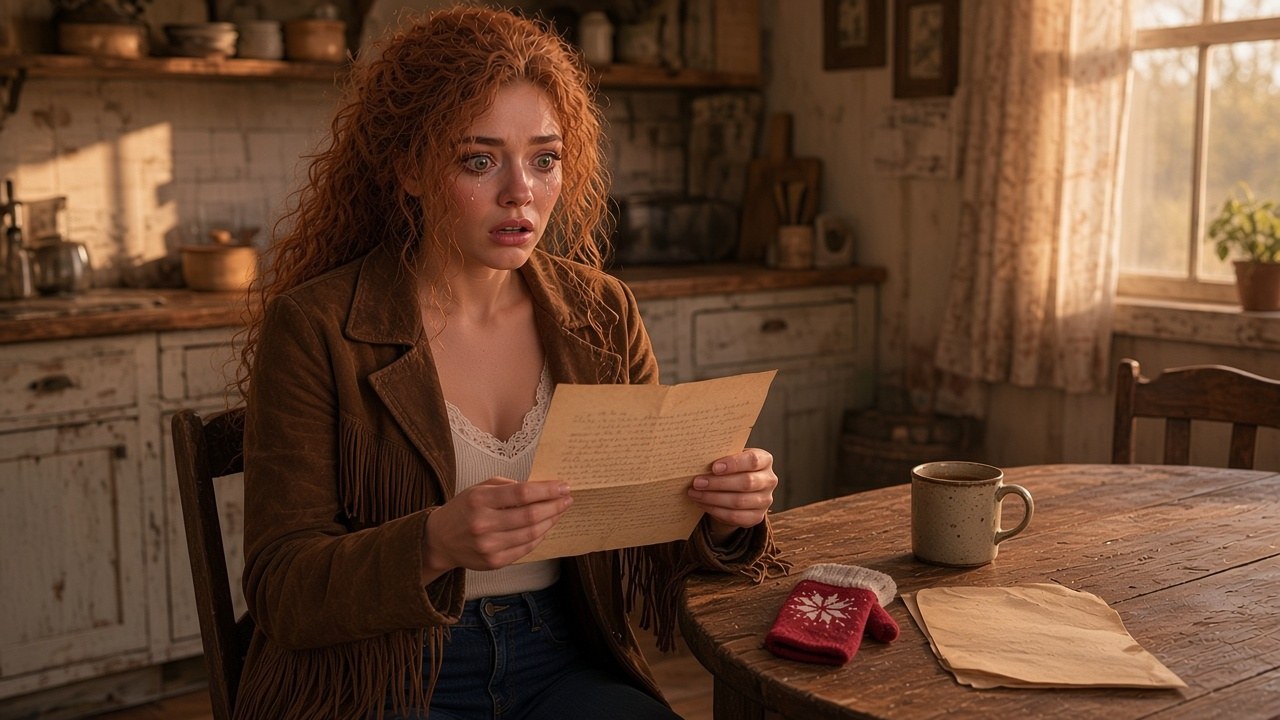
Just finding Lana’s story? Read Part 34 here to catch up on Rita’s arrest, the truck with one headlight, and what Grandpa Hank sewed into his coat.
Last time, Rita Lane told us Grandpa Hank sat at her kitchen table until sunrise the night of the creek crash.
She said he made her write down who was driving that car. Then he folded the paper into his coat and kept it there.
Cole arrested her at the gate. And back at June’s table, Annie finally told Vera everything.
Then June found a seam inside Hank’s barn coat that she never sewed.
Inside was an envelope in Hank’s square pencil letters. JUNE. ONLY IF RITA EVER SAYS MY NAME.
In it was a tiny red mitten, faded almost pink. And a page in Rita’s handwriting.
Hank, you want to know who was driving that car tonight. I’ll tell you. But you’re not going to like the name.
I read the next line twice. Then I looked up at the woman across the table, and I couldn’t say a word.
The Name on the Page
The woman across the table was Annie.
She was still holding her coffee cup with both hands. Her eyes were red from two hours of telling the truth.
“Lana?” she said. “What does it say?”
I didn’t want to read it out loud. I wanted to fold it back up and sew it right back into that coat.
But Vera was standing beside me. And Vera had spent twenty-three years being protected from paper.
So I read it.
“It was my sister,” I said. “Annie drove that car into the creek. I tried to grab the wheel.”
Nobody moved.
The clock over June’s stove ticked so loud it sounded like somebody knocking.
Annie set her cup down very carefully, like it might explode.
“That’s a lie,” she said. Her voice didn’t even rise. “That’s a lie, and she knew it was a lie when she wrote it.”
Vera’s fingers went tight around my arm.
I could feel her shaking. I knew exactly what she was thinking, because I was thinking it too.
Two sisters. Two stories. And one of them was locked up in Cole’s car right now, unable to answer anything.
June held out her hand. “Give it here, honey.”
I passed her the page. She put on her reading glasses, the ones she keeps on a string so she can never lose them.
She read the whole thing without saying a word. Her lips moved a little, the way they do in church.
“Keep going,” she said. She handed it back to me. “Read the rest. All of it.”
So I did.
Rita’s version went on for half a page. Annie behind the wheel. Annie crying. Annie driving too fast on the ice.
Rita in the passenger seat, begging her to slow down. Rita climbing out the door and swimming for the far bank.
It was a good story. That was the worst part.
It was neat and slanted and sure of itself. The kind of handwriting people believe.
Annie had both hands flat on the table now. She was staring at the wood grain like she could see that night in it.
“I was in the bathroom for two minutes,” she whispered. “Two minutes.”
What Rita Wrote at the Bottom
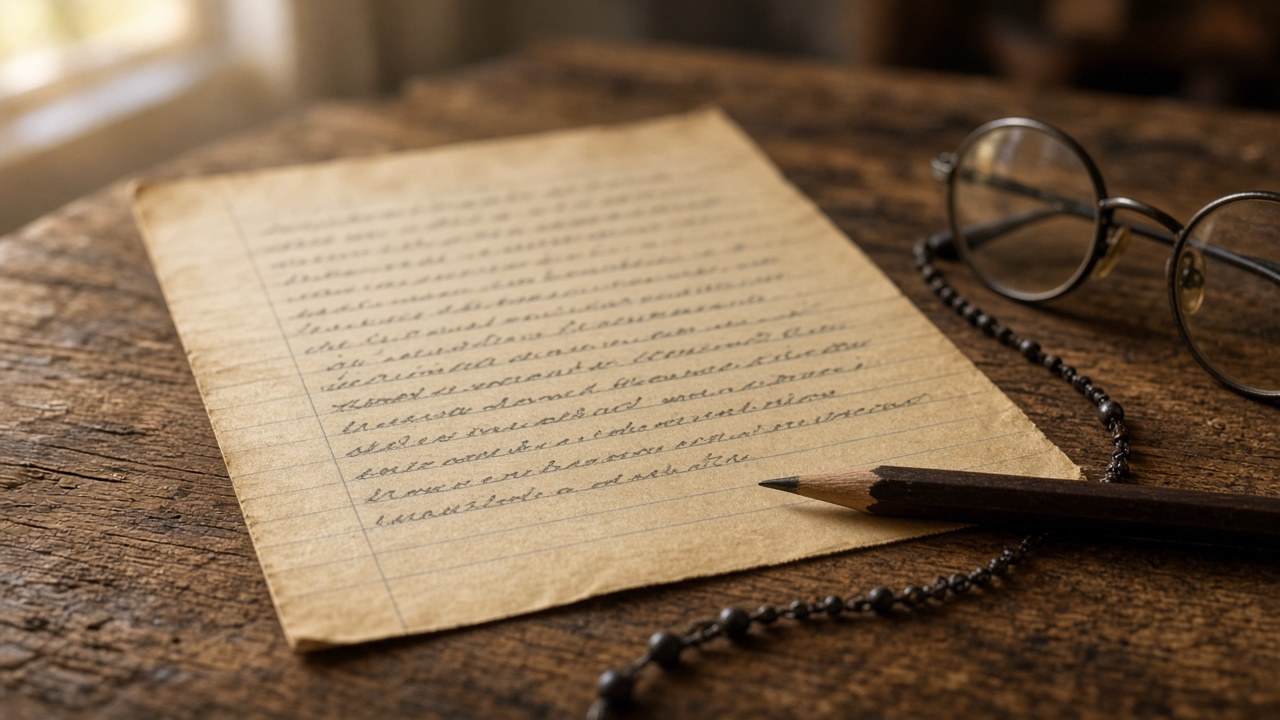
Then I got to the bottom of the page, and the handwriting changed.
It was still Rita’s. Same slant. Same loops on the L’s.
But the pencil was pressed so hard it had nearly torn the paper. And the letters wobbled, like her hand wouldn’t hold still.
There was a gap of a few lines first. Like she’d stopped. Like somebody had made her stop.
I read it slowly. My voice didn’t sound like my own.
“Hank put the mitten on the table. It fell out of my coat pocket when he hung it by the stove.”
“So I will write it true this time.”
“Annie was never in that car. I was driving. I took the baby out of Annie’s house while she was in the bathroom.”
“I missed the curve at the crossing. I got out the driver’s door and I climbed up the far bank.”
“I left her in the back seat. Rita Lane.”
June’s kitchen went so quiet I could hear Willow stamping out in the barn.
Annie made a small sound. Not a sob. More like somebody letting out a breath she’d been holding since she was twenty years old.
Vera let go of my arm.
She walked around the table to her mother, the same four steps as before. This time she knelt down next to Annie’s chair.
“I’m sorry,” Vera said. “For one second, I believed it.”
“So did I, baby,” Annie said, and pulled her in. “For one second, so did I. That’s what Rita does.”
I looked down at the page again. Two stories on one sheet of paper. The lie on top, the truth at the bottom.
And suddenly Rita’s line made sense to me. You’re not going to like the name.
“She wanted Hank to believe it was you,” I said to Annie. “Why would she think Hank would care?”
Annie wiped her face with the back of her hand.
“Because he was kind to me,” she said. “Every time I came into the feed store, he asked how the baby was doing.”
“Nobody else in this county ever asked. Rita knew that. She figured it would hurt him the most.”
June took her glasses off and folded them very slowly.
“Hank never liked a liar,” she said. “But he sure did know how to wait one out.”
Hank’s Square Letters
I almost put the envelope down. I thought it was empty now.
But when I picked it up, the paper felt wrong. Thicker on one side.
So I did something I’d never have dared to do with anything of Hank’s. I slit the envelope open along the edges and laid it flat.
The inside was covered in writing. Big square pencil letters, the same as the front.
June put her hand over her mouth.
“Read it to me, Lana,” she said. “I can’t. My eyes won’t let me.”
So I read Grandpa Hank’s letter out loud, at June’s kitchen table, twenty-three years late.
“June. I told you it was the Mercer heifer. That part was true. I’d never lie to you about a sick animal.”
“Clay Kettering came through the Mercers’ door about one in the morning, soaked to the knees, asking for the phone.”
“I heard him say Annie’s car. I heard him say the baby. I drove down to the crossing, but the young deputy was already in the water.”
“So I kept going toward town. About two miles on, I passed a woman walking on the shoulder. Wet to the waist. I knew who she was.”
“I got to her house before she did. Her spare key was where everybody on Mill Street knows it is.”
June laughed, a wet little laugh. “The milk can,” she said. “Everybody knew about that milk can.”
“She wrote what she wanted first. Then I put the mitten in front of her. Then she wrote the truth.”
“I didn’t take it to the deputy. That boy had already written his lie, and he’d done it to save somebody.”
“A courtroom would have handed that baby to strangers. A paper in my coat could keep her safe. So I kept it in my coat.”
“If you’re reading this, Rita said my name. That means she’s scared, and the paper still works.”
“Take it to whoever wears the badge. And June, don’t you dare be mad at that girl for living. Hank.”
There was one more line squeezed in at the very bottom, smaller than the rest.
“P.S. I’m sorry about the headlight. I never did get to it.”
That was when June broke.
Not loud. June Whitaker doesn’t do anything loud except yell at horses.
She just folded over in her chair with her hands in her lap, and she cried the way you cry when you’ve been brave for too long.
I went around the table and put my arms around her. She smelled like coffee and hay and the lavender soap she keeps by the sink.
“Every Saturday,” she said into my shoulder. “Every Saturday he told me he’d fix it.”
“He was busy, June,” I said. “He was keeping a promise.”
Royce had turned around from the window. His eyes were wet, and he didn’t even try to hide it.
“I never knew the man,” he said quietly. “I wish to God I had.”
By the door, Abel Haskins sat with his hat in his lap and stared at the floor.
“Thirty years of books,” he said. “And the most important thing anybody ever wrote in this county was in a coat.”
The Mitten Goes Home
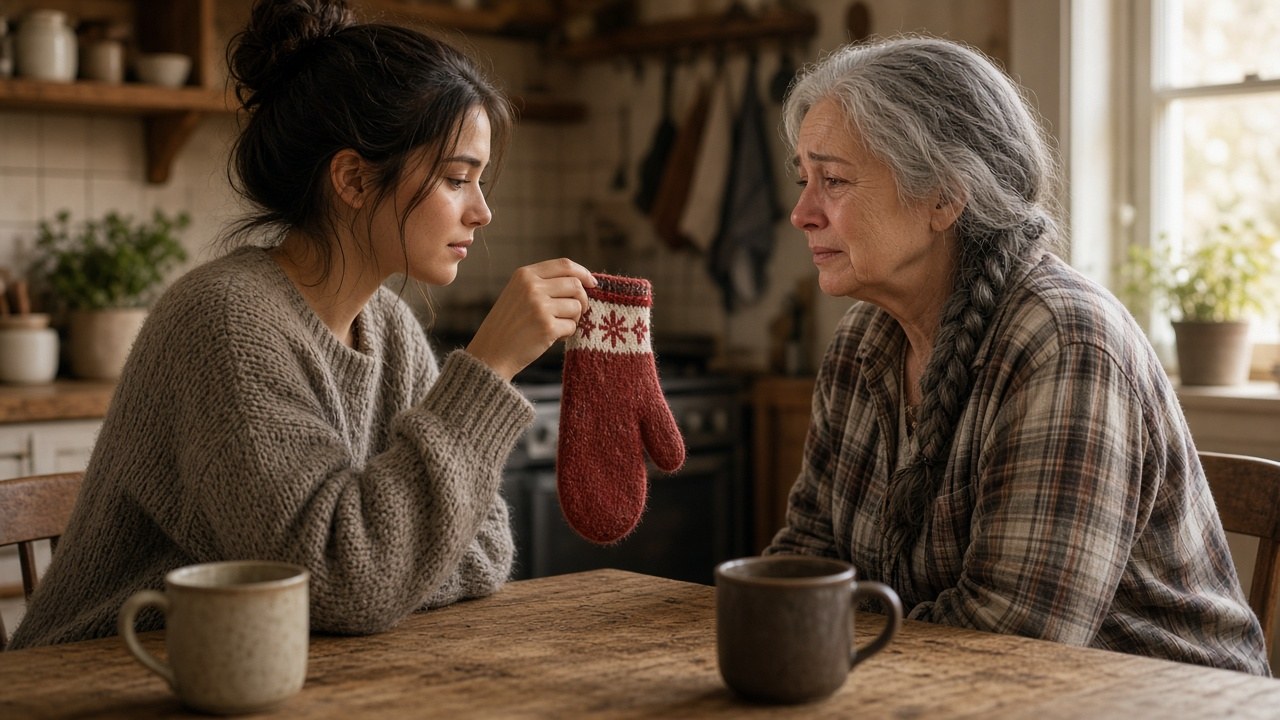
Vera picked up the little red mitten.
It was so small it only fit over two of her fingers. She held it up to the window light and turned it over.
“I don’t remember it,” she said. “I keep thinking I should remember it.”
“You were two,” Annie said. “I knitted those the winter you were born. I wasn’t very good at it.”
Vera laughed, a little broken laugh. “The snowflake’s crooked.”
“The snowflake is very crooked,” Annie agreed.
Then Vera turned her right wrist over and looked at the thin white scar below her thumb.
“It wasn’t barbed wire,” she said. “Was it?”
Nobody answered. Nobody had to.
Cole had broken that back window with his flashlight. A two-year-old’s wrist and a pane of broken glass.
Clay had told her it was barbed wire because barbed wire was a story a little girl could live with.
“I’m going to keep this,” Vera said, holding up the mitten. “After Cole is done with it. I’m keeping it.”
“It’s yours, honey,” June said. “It always was.”
I laid Hank’s letter, Rita’s page and the oilcloth side by side on the table. I didn’t want anybody’s hands on them anymore.
Then I looked over at Abel.
“Abel,” I said. “Somebody asked you to open Cole’s drawer before Rita did. You said so at the gate.”
He turned his hat around in his hands. Once. Twice.
“I did say that,” he said.
“So who was it?”
He looked at June. Then at Annie. Then at me, for a long time.
“When Cole gets here,” he said. “I’m only going to say it once, and I want the sheriff to hear it.”
“Abel Haskins,” June said. “You are sitting in my kitchen drinking my coffee.”
“Yes, ma’am,” he said. “And I’d like to keep doing that after I say it.”
I took my phone out on the porch and called Cole.
He answered on the first ring.
“Lana. Everybody all right?”
“We found what Rita was looking for,” I said. “Hank sewed it into his coat. You need to see it.”
There was a long pause.
“I’ll be there in an hour,” he said. “I’ve got something you need to see too.”
One More Page
Cole’s car came up the lane a little before four. The sun was already sliding low behind the cottonwoods.
He came in without his hat. He looked about ten years older than he had that morning.
June poured him a cup without asking. He wrapped both hands around it and didn’t drink.
Then he saw the mitten on the table.
He just stood there. A grown man with a badge on his chest, staring at a scrap of faded red yarn.
“I always wondered if anybody ever found it,” he said. His voice cracked right down the middle.
“Hank did,” I said. “He found it in Rita’s coat pocket.”
Cole sat down hard in the chair by the stove. I handed him Rita’s page and Hank’s letter, one at a time.
He read them both twice. When he got to the bottom of Rita’s page, he closed his eyes for a second.
“This is enough,” he said quietly. “Her own hand. Her own name. This is more than enough.”
Annie let out a long breath and leaned back against Vera.
For one minute, maybe two, it felt like the whole valley had finally stopped holding its breath.
Then Cole set his cup down and reached into his jacket.
“When we booked Rita this afternoon, my deputy went through her coat,” he said. “That long dark one.”
“She’d sewn a pocket into the lining herself. Down by the hem. Not near as neat as Hank’s.”
June gave a short, hard laugh. “Hank sewed a whole lot better than you ever did,” she repeated. “She was talking about herself.”
Cole pulled out a plastic evidence sleeve. Inside was a single folded page, soft and yellow at the edges.
“It’s one of the pages from her blue folder,” he said. “One she never showed us at the gate.”
He didn’t hand it to June. He didn’t hand it to Annie.
He slid it across the table to me.
“I think this one’s yours, Lana,” he said.
I looked down through the plastic. The handwriting was round and quick, with a little curl on every Y.
I knew it before I read a single word. I’ve known that handwriting my whole life, from birthday cards and grocery lists.
It was Mama’s.
At the bottom, it was signed Caroline Brooks. It was dated the week she died.
My hands started shaking so hard I had to lay them flat on the table.
“Rita won’t talk to me,” Cole said. “Not one word. She says she’ll only explain that page to you.”
“Tomorrow morning. At the jail. Just you.”
I read the first line. Then I read it again.
Clay, Rita Lane came to the farm today. She knows about the paper I signed for you. And now she wants to meet my girl.
So now I’m asking you. Why did Rita sew my mother’s letter into her own coat and carry it all these years?
What does Rita know about Lana that even Lana doesn’t know yet?
Should Lana walk into that jail alone tomorrow? And who do you think asked Abel to open Cole’s drawer first?
Next Part: Read Lana’s Story Part 36 here Follow Reiterin on Facebook so you don’t miss it.